British War Poets: By the Pen and the Sword
With the October issue of The Rake celebrating British military heroes now on the stands, we raise a sombre toast to the literary heroes produced by the horrors of World War I.

“The truly creative mind,” Pulitzer and Nobel Prize winning American novelist Pearl S. Buck once wrote, “is no more than this: a human creature born abnormally, inhumanly sensitive.” If we take ‘sensitivity’ here to mean emotional responsiveness to external stimuli, what happens when a vast cross-section of personality types are plunged into conditions that are intensely traumatic?
Perhaps the best answer we have comes in the form of the terror-soaked stanzas of the English war poets. World War I is a conflict more inextricably linked to gritty literary endeavour than any other, and it’s tempting to put this down to the realism and naturalism movement that portrayed a grainier, more visceral treatment of such horrors, that were de rigueur late in the previous century. The creative journey of one of the most publicly outspoken war poets, though, suggests otherwise.
When War broke out, Siegfried Sassoon was spending some idle years playing cricket and golf, foxhunting, writing poetry and coming to terms with his then-illegal homosexuality. Seduced by the patriotic fervour gripping British society in 1914, he enlisted first as a trooper in the Sussex Yeomanry, then with the Royal Welch Fusiliers. Sassoon’s relocation to the Western Front saw him exposed to the horrors of trench warfare – a far cry from the Victorian yarns featuring dashing heroes in gleaming uniforms with which he’d grown up in a Kent backwater. His penchant for literary romanticism held out for a while: reviewing the poetry his friend Robert Graves was preparing for publication, Sassoon – an ardent admirer of the flowery syntax and imagery of the romantic poets, along with the king-and-country positivism of Rupert Brooke’s sonnets – found Graves’s work indulgently, unpalatably gritty.
Witnessing first-hand the Battle of the Somme, the first day of which he later described as a “sunlit picture of hell”, then the Battle of Arras in April 1917, cemented the pacifist leanings so eloquently set out in a letter to The Times, written during a convalescence spell back in England while he was suffering from a shoulder wound and acute “survivor’s guilt”. It was in a shell-shock hospital, Craiglockhart – he was likely sent there to be silenced - that he met a poet whose critical and public reputation would go on to exceed Sassoon’s, and all on the strength of a body of work created almost entirely over 14 months.
Wilfred Owen was working as a private tutor and immersing himself in the mercurial stanzas of Keats and Shelley near the French Pyrenees when, on a street corner 1,200 miles away in Sarajevo, a pistol bullet killed Archduke Franz Ferdinand of Austria and his wife. Commissioned as a second lieutenant, he suffered a series of traumas – suffering concussion after falling into a shell hole on one occasion; being in exploding range of a trench mortar on another, as well as spending several days lying unconscious on an embankment amongst the remains of a fellow officer – before ending up at Craiglockhart, where Sassoon, along with Graves and H.G. Wells, would act as literary mentors.
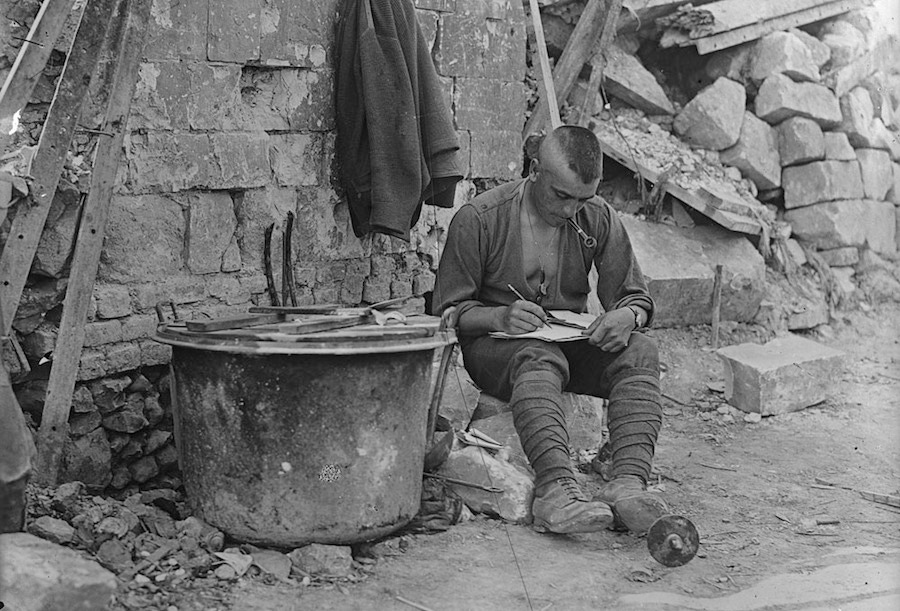 Amongst the rubble and wreckage of war, a pipe smoking soldier perches on a rock with his pen and paper.