Dancing Down the Wicket: Rafe Spall is The Rake's Issue 105 Cover Star
Rafe Spall has bloomed into one of the finest all-round actors of his generation. Was it as inevitable as it seems? In an eclectic interview, the star of Trying, To Kill a Mockingbird and the forthcoming Number 10 tells TOM CHAMBERLIN why he feels like a big-hitting batsman at Lord’s...

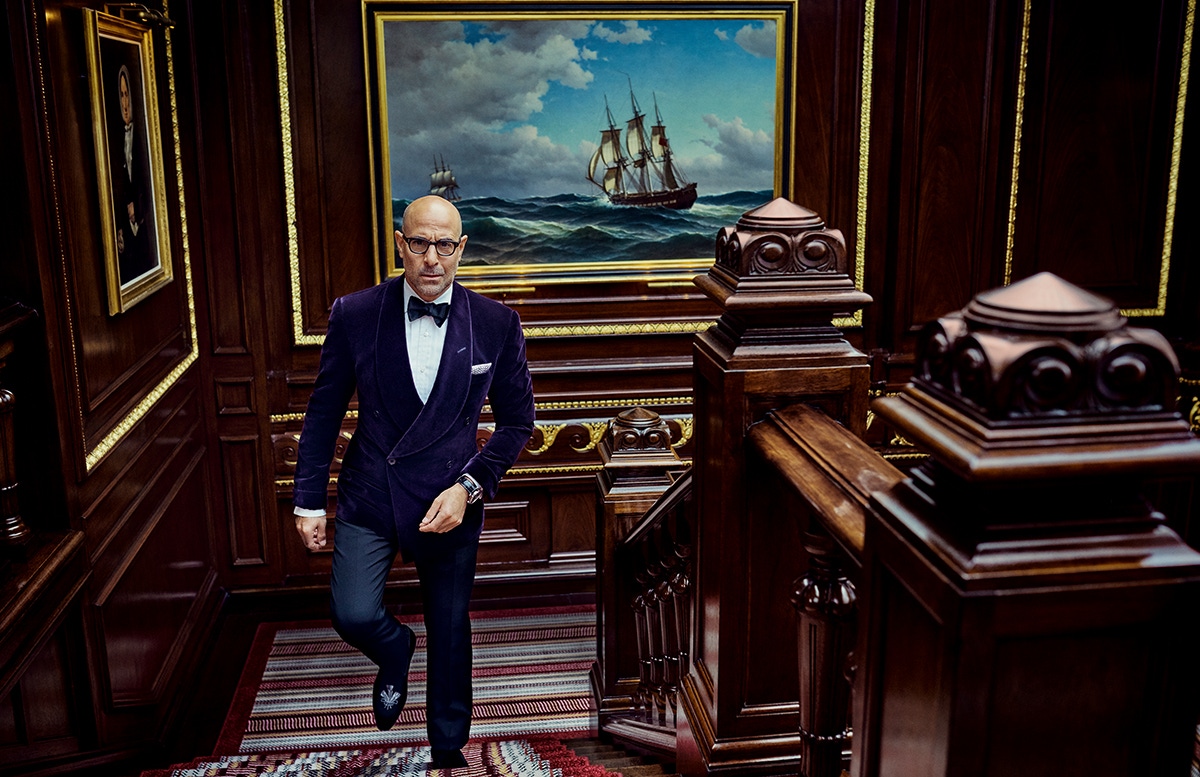
Rafe Spall looks on top of his game. His regard for British tailoring, specifically Terry Haste suits, is defined in terms of what he loves to wear (big double-pleated trousers, a silhouette more structured-military than unstructured-drape) and how confidently he wears it. He comes across as a grown-up in an industry of peacocking that often manages to miss the mark on the red carpet — Spall as a modern-day Gregory Peck. Recently you couldn’t turn a corner in London without seeing him on vast billboards advertising Sky’s Under Salt Marsh (he stars alongside Kelly Reilly, of Yellowstone fame). He is about to play the prime minister in the comedy drama Number 10, and it all seems plain sailing for a man at the height of his powers. But has it always been this way? What if he’s like the proverbial swan with furious feet beneath the waterline? We spent some time with him to see whether our perception rang true.
Spall’s career is not by any stretch conducive to the modern desire for virality, in which people are sent up and down the greasy pole of notoriety at breakneck speed, often never establishing a decent body of work. Rafe’s path has been a slower, more mature and, dare I say, more British approach: be professional, make mistakes, learn from them, be valiant, and never stop ploughing forward. That through-line runs from Shaun of the Dead, Hot Fuzz, One Day and Prometheus to Life of Pi, Betrayal, The Big Short, Jurassic World: Fallen Kingdom, The Salisbury Poisonings, Trying, and To Kill a Mockingbird.


The confidence he enjoys now did not come easily as a youngster, owing to his place in the adolescent pecking order. “I was overweight, and if you’re overweight and you also fancy girls, you need to find ways to be attractive to them,” he says. “But there is no more discerning female than a 17-year-old. They have time and options. And they will not suffer for anything other than perfection. I was chubby so I had to try and be funny. I had to work really hard, and it was purely for female attention.”
He was bright and articulate, but, as with many creatives, those qualities were not reflected in his schoolwork, try as he might. One thing he had control over was making people laugh, and to some extent that was his superpower in those years when we all want to distinguish ourselves. “Then again,” he adds. “School reports said I was disruptive.” His home life was stable, and allowed him to lean into his performative bent. This was partly because his father is the celebrated and much-admired character actor Timothy Spall. “My father was definitely my hero in every way, really, but certainly my comedic hero,” Rafe says. “I remember once, watching the Eurovision Song Contest with him when I was about 12. I sat on this pillow, and he made me laugh so much that by the end of it, the pillow was completely sodden with my pee. He was just so funny. My father is a big figure, and I always saw people respond to him because he was funny and charming and warm.”
His father helped him with technical advice. “My father always brought me up with the idea that you shouldn’t see the strings with a performance,” Rafe says. “I think you want to watch a performance, watch actors, and you want to go, ‘I wonder how they’re doing that... I don’t actually know how they’re doing it’.”


My father is a big figure. I always saw people respond to him because he was funny and charming and warm.
The tutelage from Spall Sr. that schooling could not provide included a theatre allowance. Rafe says: “If I was to give advice to a young actor now, I’d say it is absolutely imperative that you are familiar with the canon of western theatre and film. My father would give me a theatre allowance, £40 a week, because from a young age, when he ascertained that I was in it for the right reasons, he was like, ‘Well, this is part of your education’. Ninety per cent of theatre is pretty terrible, but if you’re going to be an actor, that’s informative. I went to see everything. I read everything. If you were a boxer, I think you need to have a deep knowledge of the history of boxing, of the people that came before you. And to work out that you box like you do because of the people that boxed before you.”
There are specifics in the history of acting he is drawn to. “I get a thrill from watching Olivier in something like Richard III. And then you watch O’Toole and Burton, and Harris, and you realise they’re all copying Olivier: that kind of staccato delivery, that way he talked. For a while that’s how they all did it, because what he did is that he started to attack verse in a very masculine, ballsy way. In a way, that hadn’t been done before. People had leaned into the poetry of Shakespeare rather than really seizing the aggression behind it, the muscle. [Olivier] did that, and it changed acting.
There was something slightly unruly about young Spall onscreen — something quick and eager. He doesn’t carry Edgar Wright’s landmark zombie-comedy film Shaun of the Dead, but he is participating in a world that depends entirely on rhythm, timing and the ability to land a line or reaction with precision. The 2004 movie has become a cult cornerstone of British comedy, but for Spall it also looks, in retrospect, like an early workshop in pacing: learning how to exist in a heightened comic register, beyond school, at least.


I get a thrill from watching Olivier in something like Richard III. He started attacking verse in a masculine, ballsy way.
His apprenticeship continued in the wider Wright orbit, notably Hot Fuzz and later The World’s End; all three would come to be known as the Cornetto trilogy. Spall’s remarks on comedy are illuminating here: “I think you can’t be funny without being clever, because people laugh generally at things they recognise, and in order to identify things that other people recognise, you need to have some form of intelligence. I think a lot of comedians are extremely fine-minded people. I would argue that comedic actors can be serious, but the inverse is rarely true. Look at Adam Sandler — I think he’s a genius. Jonah Hill, Steve Carell. [It’s] very difficult to make an unfunny actor funny. I think you need funny bones. I say it’s maths. I’m in a scene, and it feels a bit like The Matrix: things slow down and I can see lots of figures, and I go, ‘That joins into that, that’s the rhythm of that, that then needs to come onto that in order to sell that in order to make that’. All while looking like you’re not doing it at all.”
Then came the period in which his face became familiar to larger audiences, and familiar in different modes. One Day gave him a bruised-romantic register. Prometheus placed him inside the machinery of a major science-fiction property. Life of Pi let him appear in a film of unusual ambition and spiritual grandeur. These are not identical achievements, but taken together they show a widening circle of trust. Directors of different sensibilities were finding room for him: Lone Scherfig, Ridley Scott, Ang Lee. That is rarely accidental. It shows that an actor’s reputation among filmmakers has deepened beyond the first impression. The performer who was once an agile comic supporting player has become something more elastic: a man able to inhabit mainstream entertainment, intelligent drama and tonally uncertain material without seeming miscast in any of them.
Things got nerve-racking for him when he made his Broadway debut in 2013 alongside Daniel Craig and Rachel Weisz in Harold Pinter’s Betrayal. Many actors talk about fear as something to be abolished. Spall’s more interesting position is that nerves are useful if harnessed properly. His description of opening night is one of the most vivid accounts of professional nerves one could hope to hear: the sense of his body shutting down, the awareness of the famous faces in the audience, the fork in the road between surviving the night unscathed and daring to be creative.
Grooming: Jo Jenkins
Digital Technician: Derrick Kakembo
Lighting Technician: Joey-Philippe Dali