Optimum Prime
Sculpture, personality and function: Gaziano & Girling’s shoes have always had it all. When they announced a new craft service pitched between made-to-order and full bespoke, THE RAKE lined up for a fitting.

The record has shown for a while now (for those who care to look) that I am a little obsessive about shoes. I like how they look. I sometimes hate how they look. They cover all manner of sins. Feet aren’t always the prettiest things in the world. The shoemaker’s art — once a purely practical vocation — has become the highest expression in luxury.
Sad to say, but the number of extant shoemakers is now pitifully small. The world is too used to, and accepting of, cheap footwear made in some far-off land where labour is cheap and craftsmen are non-existent. So we at The Rake are here to act as a bellows for the artisanal embers of shoemaking, and in this issue our lust is turned to Gaziano & Girling.
They may see this as mild praise given that King Charles has granted them a royal warrant, including his coat of arms in a newly liveried logo. Apart from the impressive patronage, the brand is known for its broad made-to-order collection, with slick designs and colours providing for all manner of tastes and wardrobes.


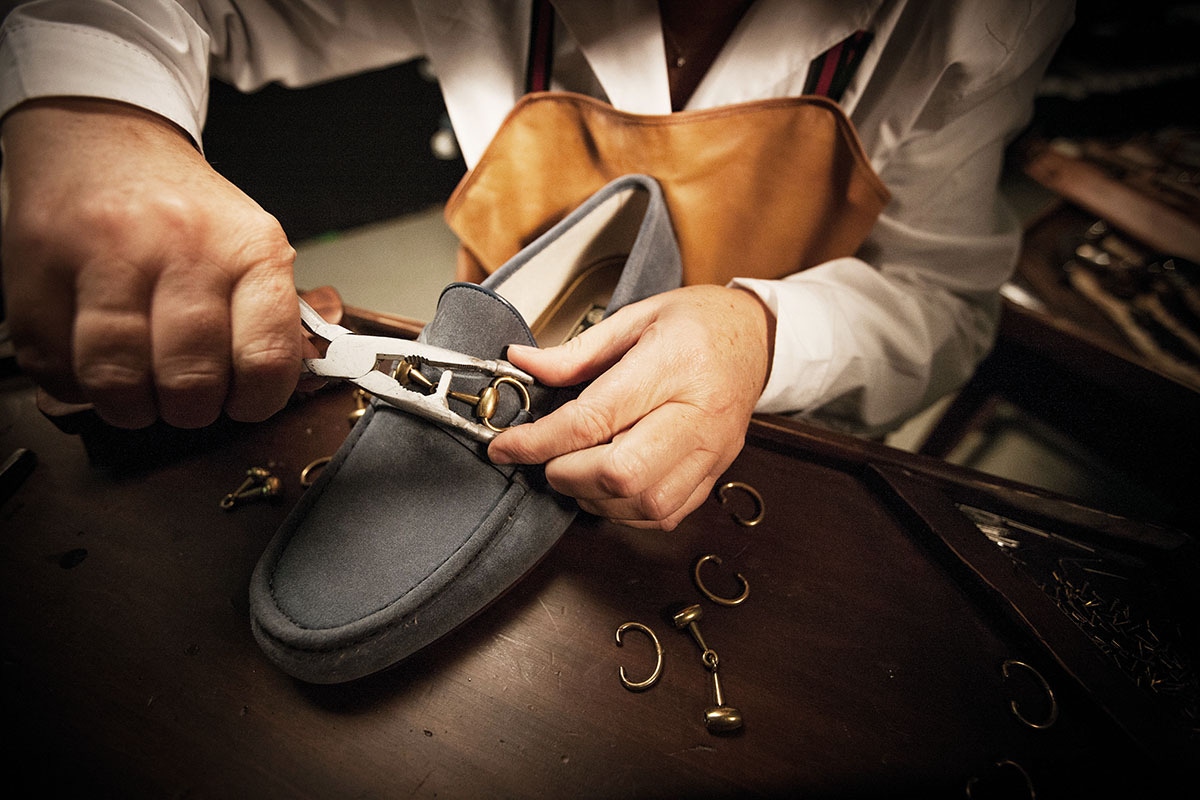
Gaziano & Girling make their shoes in their own factory in Kettering, and it is an impressive place to visit. They also have a full bespoke service, which has been a home to great shoemakers such as Daniel Wegan. The brand’s eponyms, Tony and Dean, who once found themselves doing a lot of front-of-house and business-leaning jobs in their work, are now back to their main purpose: making shoes by hand at the bench. That return to the coalface helped inspire the idea for a new service, which they call Optimum.
It sits between made-to-order and full bespoke. It is an enticing service in which the shoes are made by the bespoke team, with hand welting and all the techniques that machines are unable to replicate, using a last shape from their M.T.O.; they make a wooden last from that to make the shoes. This is for people who have worn enough M.T.O. from the brand to know what works for them and what does not. I, for example, do not suit the Deco last — I am too broad and tall for it — but I have several shoes using the KN14 last. For this pair we went for that and the Ashby style, as I love that it is the most formal slip-on you can find, with a beautiful toe cap and brogued strap. With those decisions made, it was off to Kettering for the process to start.


Once the pattern is made up, the first bench job is hand- clicking,cuttingtheupperpiecesfromafullhide.Toanuntrained eye, leather is leather; to a master clicker, it is a landscape of strengths and weaknesses. Either side of the backbone in the 'butt' area offers tight, dependable fibre for a vamp that must remain smooth for decades. The shoulders can yield firm, consistent quarters. The belly, for all its softness, is avoided for structural components. With a sharp, palm-sized knife, the clicker traces each pattern piece much like a cutter would a bolt of cloth. Machines can cut with speed; only the human hand can cut with foresight. A skilled clicker reads future behaviour from a flat surface — how the leather will stretch over the last, how it will crease, how it will age.
Stitching, skiving, brogueing and binding — all the delicate, fiddly work that reveals the shoe’s design starts now. Whether the last is a bespoke creation or a refined house standard, the way the upper is shaped hints at the finished form: the proud instep, the sweep of the sidewall, the forward line of the toe. The pattern’s purpose shows here, as it must work in harmony with the last shape to be worked round the last and tacked into place. Here the task is to stretch, tense and smooth without bruising the surface. The maker must decide exactly how much strain the leather can bear — where it should relax and where it must hold.
With the shoe now recognisably a shoe, the work moves to its hidden structure: hand-welting. This is the engineering heart of fine shoemaking, and the step that separates handmade from merely hand-finished. The maker cuts a rib — a small, precise ridge — into the insole, then stitches the upper and welt together using a waxed linen thread. Each stitch is made by hand with a curved awl, piercing leather one hole at a time. It is slow, physical work: one pair can require more than a thousand stitches. But the rewards are structural integrity and longevity. A hand-welted shoe can be resoled repeatedly without disturbing the upper, the welt acting as an anchor that endures decades of wear. It is also the method that allows for the impossibly tight waists seen in the best English shoemaking. A machine cannot work so narrowly; a craftsman can.


The maker must decide how much strain the leather can bear — where it should relax and where it must hold.
The sole is then built: shank fitted, cork laid for comfort, outsole trimmed, stitched and finished. The waist is rasped, shaped and smoothed, often into the narrow, contoured form that hugs the arch and contributes so much to the shoe’s elegance. The heel is built lift by lift, each layer nailed, trimmed and inked before the stack is shaped into a single clean sweep. A well-made heel looks like a continuation of the last, not an afterthought.
Finally comes finishing. Edges are inked and polished; the sole is burnished; the uppers are coaxed into depth and life with dyes and polish. This final phase is not cosmetic pretence; it is the maker’s signature, the moment where the shoe acquires the personality that will continue to evolve with the wearer. The final result, especially once the polish has worked its alchemy, edges into that delicious territory where one isn’t entirely sure whether the shoes should be worn or displayed. There is sculpture here, as well as function. I recommend the Optimum line without hesitation. Most men stop at made-to-order, content with its high watermark, but Optimum pushes beyond it — an ascent towards the bespoke ideal without crossing fully into that refined chamber. It is craft raised to its highest register.