The Lange and Short of It
Compromise is anathema to A. Lange & Söhne. How do they maintain their exacting standards? Wilhelm Schmid, the Chief Executive, is the man to ask.

Dedicated autophile Wilhelm Schmid was overseeing BMW’s operations in South Africa when, in 2011, a call came from Richemont offering him the chance to lead a Glashütte- based watchmaker it had owned since 2000 and that was founded by Ferdinand Adolph Lange in 1845.
Already by then a watch enthusiast — one with several Lange pieces among his collection — Schmid set about the task with zeal and perspicacity, applying a turbo-charged version of the quality-over- quantity concept to horology (A. Lange & Söhne are known for producing only a few thousand lavishly decorated iterations of the Lange 1, Zeitwerk, Saxonia, 1815, Richard Lange and Odysseus families, all with twice-assembled proprietary movements, each year).
Indeed, the company has come a long way since the Soviet administration nationalised the company’s property in 1948, and for the past decade and a half Schmid has steered the manufacture through the post-financial crash era, the rise of the smart watch, volatile consumer preferences and a global pandemic. “Never waste a good crisis,” he tells The Rake when we catch up with him during a visit to the manufacture’s new boutique on Bond Street in London.

We don’t look too much at what others do. We just know what our clients like.
I’m a businessman, so I’d love to produce more watches, so I could sell more watches. But our people — the people who assemble, decorate, polish, engrave and produce the dials for these watches — they can only work a certain amount of hours. We have about 650 people in the factory on the production side. So we only make about 4,500-5,000 watches a year. We cannot just respond to market demand for more or less watches. That’s not our business model. It’s about structure and capacity.
The moment you take a good watchmaker away from one movement and shift him or her to another movement, you’re going to lose six to nine months in the process.
Have you been to the Louvre and seen the Mona Lisa? Do you remember the frame? I’m pretty sure it’s the most beautiful and gorgeous frame in the whole of the gallery. But the painting is the star, not the frame. That’s how marketing should be: only the frame around our watches. It should only beautify watches. That’s why marketing for us is not a driving force. At Watches & Wonders, all we have is a giant watch in the centre of our booth, and I think that says it all.
All of us are custodians of our watches. And the secondary market is important because our watches will outlive all of us. I believe about 90 per cent of the pocket-watches A. Lange & Söhne built in the past still exist. Good watches outlive their first and second custodians.


Ninety per cent of the pocket-watches we built in the past still exist. Good watches outlive their early custodians.
Proper service and repair is crucial. If a watch gets a dent or a scratch, there are two ways of dealing with it. One is polishing, which means you take material away until you reach the bottom of the damage. Or you can do what we do: take a laser, take exactly the same material, fill the little dents and scratches, then polish the results. It maintains the integrity of the design. It maintains the weight of the watch. And it’s sustainable — you can do it repeatedly. Polish scratches away, and you end up with a diminished caseback.
We work with uncoated and untreated German silver, a beautiful alloy introduced in Saxony in 1823. It’s provenly the best metal [for our purposes] in centuries. However, if you touch it, you have to machine it to get it clean again, otherwise it will develop a very ugly patina. Grease or acid on the skin diminishes it.
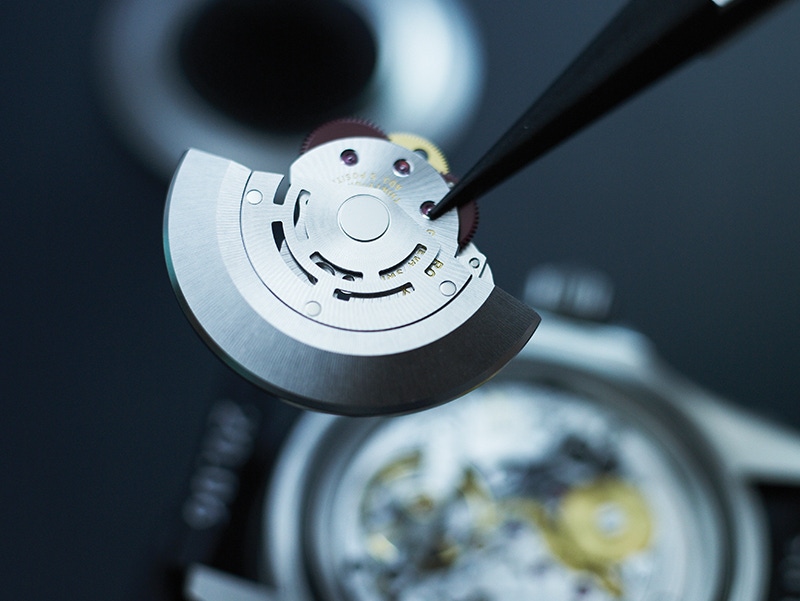
Two-fold assembly? Our movements are designed in a way that a watchmaker has to adjust all the tolerances. They assemble it, and then if the movement passes all tests, it will go back to the watchmaker and he or she will disassemble it, clean it, then — after decoration — reassemble it, encase it and work again and again through the same test work. This has two advantages. Firstly, it means that any problems are addressed with the watch still in our hands and not on a customer’s wrist. Secondly, it means we can provide the highest aesthetic and technical quality.
Even complicated watches should be waterproof. Making minute repeaters waterproof isn’t for the sake of it — there is a purpose. In Dubai, in shopping malls, it can be 15 degrees Celsius but 40 degrees outside, which causes condensation. If you have a watch that is not waterproof, humidity will creep in. In many countries you will get moisture in there and it will develop rust and corrosion.

True craftsmanship is reflected in clients’ eyes. Successful businessmen and watchmakers — very different types of people who usually would never meet in life — come together because they are passionate about the same thing. There’s an immediate connection. A.I.? No one will ever have that connection with a computer.
Being asked about your favourite watch is like being asked about your favourite child. My usual answer is it’s the Datograph Up/ Down launched in 2012, because it’s the first watch that I had the great privilege of working with the team on. I’ve had the privilege of working for A. Lange & Söhne for 15 years. That’s quite a long journey, and I still love it every day.
Who has influenced me the most? I never met him, because he passed away before I entered. But I would have loved to meet [the visionary A. Lange & Söhne co-founder] Mr. Günter Blümlein. I think he was a genius. A lot of things we do today are still based on his foundations, on his rules, on his design ideas. The spirit that he left behind in the company has influenced me more than anything else.
The watch industry will always have ups and downs. But I’m of the belief — I can’t prove it, but I have yet to find somebody who disagrees with me — that never, ever in the history of watches have there been more people interested. What used to be a hobbyist subject, a small circle of people interested, has grown so much today, and I don’t see any reason why it should not continue growing. As long as the next peak is higher than the previous peak, and the next valley is higher than the previous valley, the trend is still intact.
We can deal with any challenge. A. Lange & Söhne survived 45 years of communism? We’ve seen so much worse than anything we can expect to see right now.
Adversity helps you push boundaries. It helps you to change things that you wouldn’t change during the good times. Times of crises are the times to deal with structural and other challenges and overcome them — the things you don’t touch when you’re flying high. Adversity fuels creativity.