Follow Suit: Marlene Dietrich
Marlene Dietrich defied convention and pursued authenticity, not least in her commitment to androgynous style. In fact, her wardrobe was a canvas for female sexual empowerment.

Has anyone worn a tuxedo with more presence than Marlene Dietrich? Perhaps Cary Grant or David Bowie — but did they exude the same charm and charisma? The same sensuality and allure? When Dietrich, sporting a suit with a top hat, improvised the first lesbian kiss on screen by a leading actress in a Hollywood film — in Josef von Sternberg’s Morocco (1930) — she cemented herself as a cultural icon to rival any man of her time.
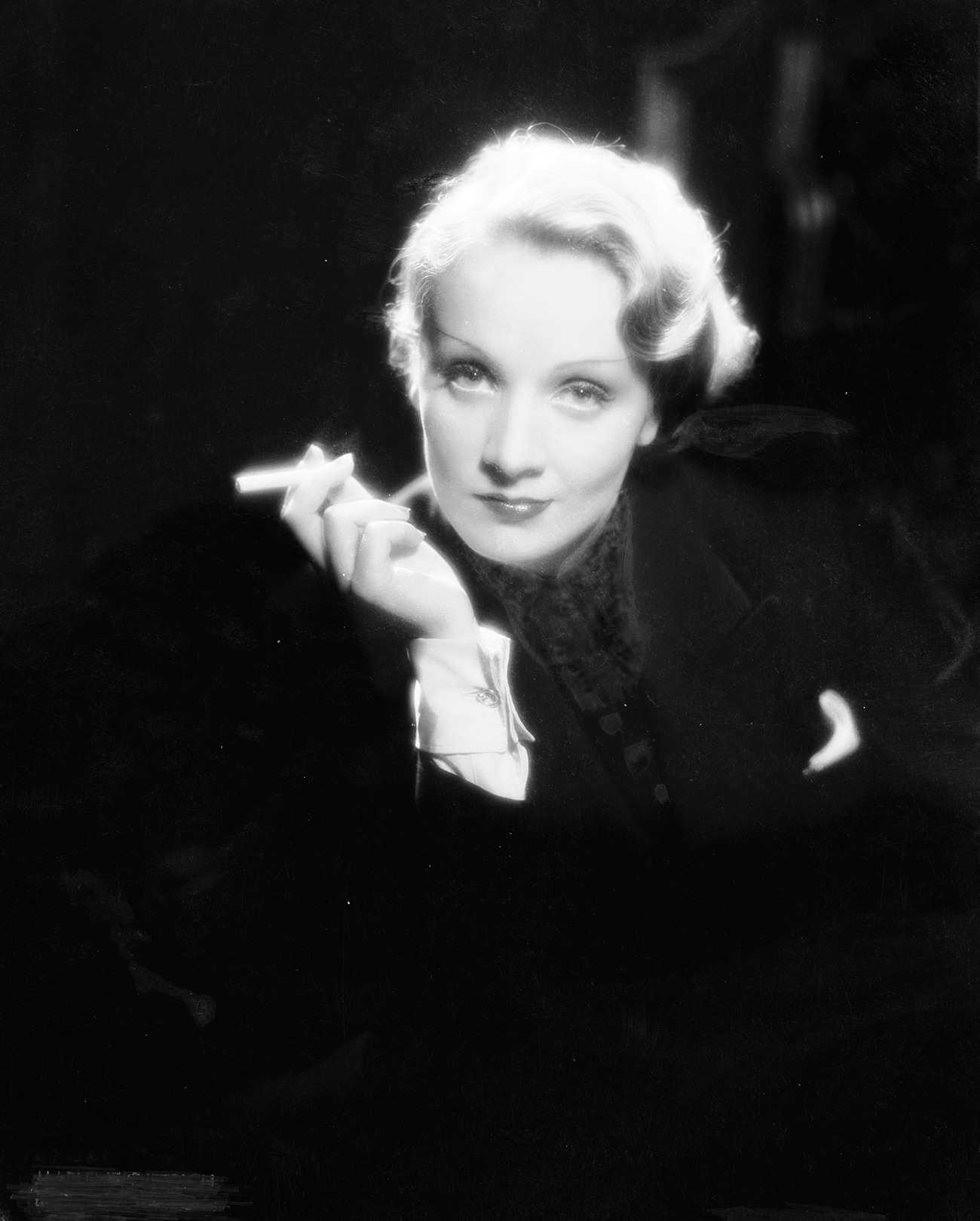
My first parasocial encounter with Dietrich came from a photograph. Like many, I came across the famous picture of the star dressed in her aforementioned tuxedo and top hat, smoking a cigarette — a photograph that featured in the V&A’s 2022 exhibition Fashioning Masculinities — and was instantly mesmerised. In fact, I was torn between developing a crush and the temptation to buy a tuxedo for myself.

Although Dietrich described fashion as a bore, she still used her carefully curated image to challenge gender conformity as a political stance, and in the progress she emerged as a style legend. “I dress for the image,” she said in a 1960 interview with The Observer, “not for myself, not for the public, not for fashion, not for men.” During a time of strict gender norms, Dietrich was a pioneer of androgynous fashion, and she can be partly credited for the popularisation of the style. Sporting suits and men’s clothing as frequently as she wore gowns and fine jewellery, the actor’s wardrobe acted as the perfect canvas for her air of female sexual empowerment. In the process, Dietrich inspired a generation of performers, including Queen and Madonna, and is credited as the inspiration behind Yves Saint Laurent’s legendary Le Smoking jacket. The designer himself proclaimed, “A woman dressed as a man must be at the height of femininity”.


Born in Berlin in 1901, Dietrich was one of the most enigmatic and rebellious stars of the Golden Age. She lived as she pleased, with a glamorously provocative persona she embodied on and off screen. Bursting onto the Hollywood landscape after a successful career in shows and silent films in Germany, Dietrich brought the bohemianism and cabaret culture of Weimar Berlin to American pictures. Morocco was her introduction for American audiences, and a groundbreaking film for its gender representation, cinematic style and genre. The scene in which Dietrich, as Amy Jolly, a cabaret singer in a foreign land, performs in a Moroccan nightclub gained her international fame and an Oscar nomination.
Following her breakout role, Dietrich went on to star in films such as Shanghai Express (1932), The Scarlet Empress (1934), Destry Rides Again (1939), and Witness for the Prosecution (1957), to name but a few. Whether she was portraying a femme fatale, Catherine the Great, a tough but charming saloon singer or a calculating wife, Dietrich’s characters — in contrast to the more demure heroines of the Golden Age — were as bold and self-possessed as she was. In her personal life, Dietrich was as charismatic and scandalous as the characters she played. Despite being married to Rudolf Sieber until his death in 1976, she was known for having many lovers. Her little black book read less like a diary and more like a list of the 20th century’s most powerful men: fellow stars such as John Wayne and Gary Cooper, writers Ernest Hemingway and George Bernard Shaw, and John F. Kennedy and his father, Joe.
Her characters, in contrast to the more demure heroines of the Golden Age, were as bold and self-possessed as she was.